UFC 330 is scheduled for August 15, 2026, at Xfinity Mobile Arena in Philadelphia. Welterweight champion Islam Makhachev is set to defend his title against No. 1 contender Ian Machado Garry. This article updates regularly with any new information up until fight night.
Styles
Ahh… the classic wrestler vs. striker matchup. Of course, adjusted for 2026 standards of what striker vs. wrestler means. We’ve seen Garry grapple and he’s got a sub under his belt. We’ve also seen Makhachev get some knockouts but we know what their specialties are.
Makhachev is a wrestling-led control fighter who uses measured pressure, striking and hand fighting to deny space and get to the clinch. He is a master of chaining positions together even if his opponent denies the first attempt.
Garry is a long-range striker whose game is built around keeping opponents at the end of his kicks and straight punches, then exiting before they can return fire.
Garry’s challenge is to stop Makhachev from chaining one position into the next. Otherwise, he could spend most of the fight defending instead of building meaningful offense of his own.
Tale of the Tape
| Attribute | Islam Makhachev | Ian Machado Garry |
|---|---|---|
| Record | 28–1 | 17–1 |
| Age | 34 | 28 |
| Height | 5’10” | 6’3” |
| Reach | 70” | 74” |
| Stance | Southpaw | Orthodox |
| Last five fights | 5–0 | 4–1 |
| Weight | 170 lb | 170 lb |
Makhachev gives away five inches in height and four inches in reach. Garry is also six years younger. Makhachev has the much deeper title-fight record and has won 16 straight UFC fights.
| Fight | Islam Makhachev | Ian Machado Garry |
|---|---|---|
| Most recent | W — Jack Della Maddalena, unanimous decision | W — Belal Muhammad, unanimous decision |
| 2 | W — Renato Moicano, submission, round one | W — Carlos Prates, unanimous decision |
| 3 | W — Dustin Poirier, submission, round five | L — Shavkat Rakhmonov, unanimous decision |
| 4 | W — Alexander Volkanovski, head-kick stoppage, round one | W — Michael Page, unanimous decision |
| 5 | W — Alexander Volkanovski, unanimous decision | W — Geoff Neal, split decision |
Makhachev’s five-fight run includes two full championship decisions, two submissions and a first-round knockout. All five of Garry’s most recent fights reached the scorecards. His recent performances have been built around winning rounds through movement, distance control and steady output.
| Statistic | Makhachev | Garry |
|---|---|---|
| Significant strikes landed per minute | 2.45 | 4.78 |
| Significant striking accuracy | 58% | 54% |
| Significant strikes absorbed per minute | 1.45 | 2.86 |
| Significant strike defense | 61% | 52% |
| Takedowns landed per 15 minutes | 3.10 | 0.92 |
| Takedown accuracy | 56% | 31% |
| Takedown defense | 91% | 80% |
| Submission attempts per 15 minutes | 1.0 | 0.4 |
| Average control time per UFC fight | 5:38 | 1:43 |
| Control time as a share of total fight time | 51.2% | 11.6% |
Career rates come from the UFCStats profiles for Makhachev and Garry. Control averages and percentages were calculated from recorded UFC control time and total fight duration. Makhachev’s aggregate control time is also listed in the UFC record book.
The numbers describe two different kinds of fights.
Garry lands almost twice as many significant strikes per minute, but he also absorbs almost twice as many. Makhachev’s lower striking output partly reflects how much time he spends clinching, controlling opponents and working on the ground.
The control stats make that difference clearer. Makhachev has spent just over half of his UFC fight time in control, averaging 5:38 per appearance. Garry averages 1:43, and nearly 40% of his UFC control time came against Michael Page. Control is a regular part of Makhachev’s game. For Garry, it has depended more on the opponent and the circumstances of the fight.
Height & Reach
Garry’s reach is most useful in open space, where he can jab, kick and move before Makhachev reaches a leg, hips, or the clinch.
That reach lets him attack from farther out, while his long arms help him post on Makhachev’s shoulders, dig for underhooks and threaten knees when Makhachev changes levels.
Makhachev has beaten longer opponents before. Charles Oliveira has a listed reach of 74 inches, while Dan Hooker is listed at 75. Makhachev submitted both, though neither was a 6’3” welterweight who moves like Garry. 😂
Garry’s height may help him create separation. His reach advantage matters most while he still has room to move behind him.
Cage craft
Garry wants to fight at long range, but he probably does not want to spend much time near the outer edge of the Octagon.
I’ll be keeping an eye on the “warning track,” as some call it. Once Garry moves beyond it, there is little room left to retreat. Makhachev can use the threat of strikes and level changes to keep him backing up, then close the remaining distance at the fence.
The most important part of Garry’s movement may be how quickly he changes direction. Against Geoff Neal, he deliberately showed one exit before cutting back the other way, an approach he said was influenced by studying NFL wide receivers. He wanted Neal to commit his feet in one direction before Garry moved in another.
That could matter more against Makhachev than speed alone. If Garry retreats along one line, Makhachev can keep following him toward the fence. A sharp change of direction may force Makhachev to turn and adjust his pressure, giving Garry a moment to recover the center or strike as Makhachev follows.
Those cuts also create moments Makhachev could try to time. Garry has to shift his weight and bring his feet underneath him before changing direction. If Makhachev reads that movement, the exit could become an opening to attack the leg or get to the clinch.
The center gives Garry more room to defend. If Makhachev reaches his legs or ties up, Garry can sprawl, turn or circle away without immediately running into the cage. He also has more room to frame on Makhachev’s shoulders or upper body, keep their hips apart, COUNTER and then move off at an angle. Once Makhachev gets past those frames and settles into the clinch, the extra space matters much less.
Jack Della Maddalena showed the limits of holding the center. Makhachev took him down in open space and controlled him for most of the fight. JDM offered no post/frame, counter, angle, sprawl or anything in this example. He shells up and moves back in a straight line. Completely ill-prepared and it’s only the first round.
JDM had room around him, but Makhachev often reached him before he could use it. Once Makhachev gained control, JDM could not create enough space to stand and reset.
The center only helps if Garry acts before Makhachev closes distance. He still has to recognize the entry, establish his frames and move. For a more in-depth understanding of takedown defense and frames, I highly recommend watching BJJ Scout’s video on Conor McGregor.
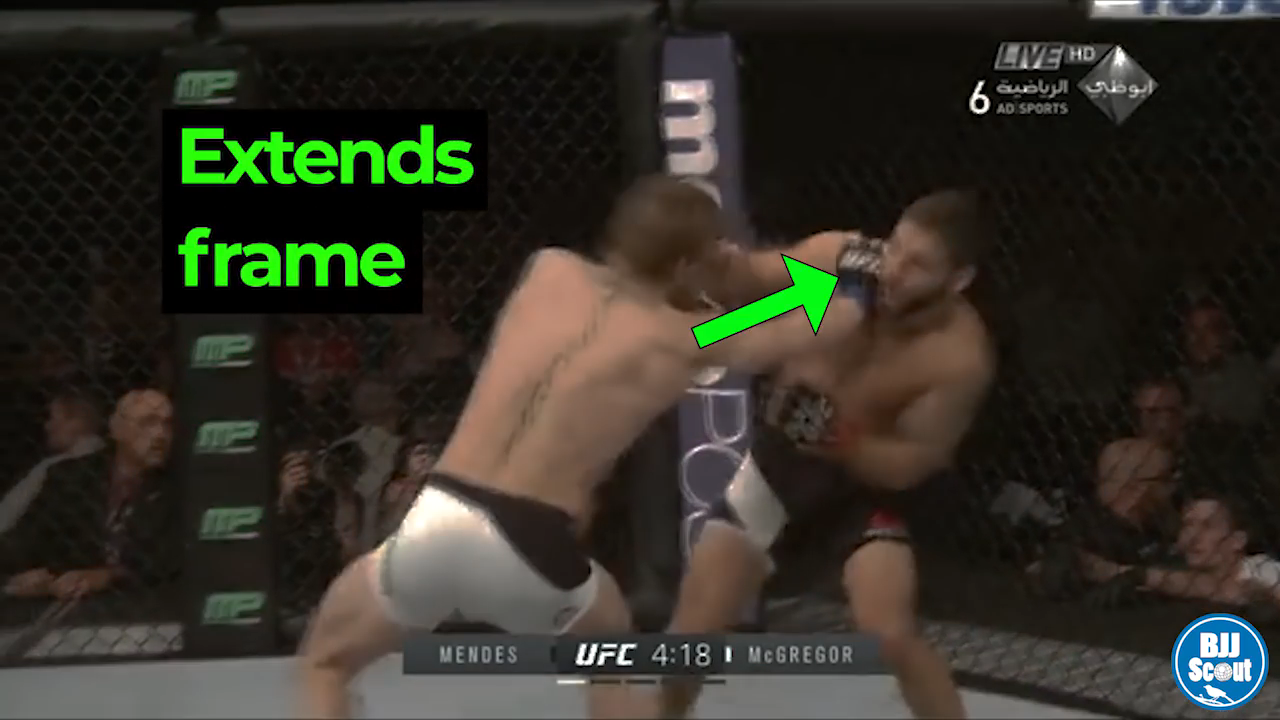
Dustin Poirier had some of his better moments against Makhachev when the fight remained in open space.
Before their fight, Matt Brown said Poirier needed to “keep the center of the octagon”.
Poirier’s coach, Mike Brown, offered the same advice after Round 1, saying, “You cannot back up to the wall. No matter what happens, you need to fight him right in the center. Whether he hits you or not, you cannot back up. That’s how he took you down on the wall.”
Garry may still use the fence to help him stand if he is taken down near it. That is different from being driven there while Makhachev already controls his hips or upper body. In that situation, the fence is more likely to help Makhachev keep him in place.
Garry probably needs to hold the center in short stretches, score at range and leave on an angle. He cannot stand still, but he also cannot keep giving ground in a straight line.
Makhachev vs. The Reach
Makhachev does not have to beat Garry’s reach with his hands alone. Low kicks and body attacks can interrupt his movement, while level-change feints may make him pause, shift his weight or lower his hands. Any of those reactions could give Makhachev a moment to close the distance.
That was clear against JDM. Makhachev attacked his lead leg throughout the fight, then repeatedly timed his takedowns before JDM could settle into his boxing.
JDM had a three-inch reach advantage, but Makhachev completed four takedowns, recorded 19:10 of control and held him to 18 significant strikes over five rounds.
Garry may present a harder version of that problem because he is taller and can change direction suddenly instead of circling at one steady pace. Makhachev may only need to catch him during one of those changes, after a kick or as he finishes the right hand. Those are the moments when Garry could be square, heavy on one leg or unable to move away immediately.
Much of the work may happen before Makhachev ever reaches his hips. The low kicks, hand fighting, pressure and feints are what create the entry.
Stances
Garry stands orthodox and Makhachev stands southpaw, which leaves both men facing an open side. Garry’s right hand and right knee have a direct line toward Makhachev, while Makhachev’s left hand and left kick travel back through the same space. The position of their lead feet matters because whoever gets his foot to the outside has a cleaner lane for the rear hand and rear kick.
Garry will want that angle for the right hand, but Makhachev can use the same battle to set up his left straight, his left kick and his entries into the clinch. Garry’s height also puts his right knee in a dangerous position whenever Makhachev steps forward or changes levels. A naked entry would put Makhachev directly on that line, so he may need to draw Garry’s attention elsewhere first.
That is where the threat of wrestling begins to shape the striking. If Garry becomes too focused on stopping the takedown and/or blocking the inside body kick, he may lower his hands or hesitate long enough for Makhachev to bring the left kick upstairs, as he did in the second Volkanovski fight. However, against Ian Garry a head kick seems much less likely because of his height.
Makhachev can also occupy Garry’s lead hand by touching, pulling or knocking the jab aside. That can briefly shorten the reach gap and give him a clearer route to the body, the clinch or the left hand.
Collar tie
One way Makhachev has handled opponents entering on him is the double collar tie. He has used it in open space to control the head, break posture and land knees. The opponent may pull away or give ground to recover his stance, allowing Makhachev to follow and move the exchange toward the cage.
That happened repeatedly against Volkanovski. Makhachev caught the double collar tie as Volkanovski came forward, then used it to land knees and interrupt his offense. Later in the fight, he used the tie to set up a trip that carried the exchange into his fence work.
Garry’s height could make this difficult.
His head sits farther away, and if Makhachev reaches from too far out, Garry has room to frame, fire an uppercut or bring up a knee. Makhachev will likely need to hide the entry behind hand fighting, pressure or a level-change feint.
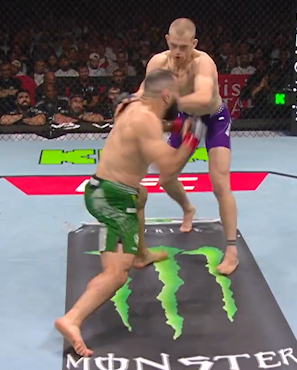
Once Makhachev gets the tie, Garry’s height can work against him. Pulling the head forward breaks his posture and takes away the distance he needs for his straight punches and kicks. Garry then has to fight his way upright, and that effort may carry him backward toward the fence. As Feño explains in our exchange above, the clinch can lead to other positions.
In open space, Garry has room to work an arm inside, raise his posture and circle away, but near the cage, those exits narrow.
Wrestling & Grappling
Garry’s 80 percent takedown defense is a strong number. UFC opponents have completed only six of the 30 takedowns they have attempted against him. Fifteen of his 24 successful defenses came against Shavkat Rakhmonov and Belal Muhammad.
The number still tells only part of the story. Rakhmonov went two for 10 on takedowns but controlled Garry for 11:41.
Muhammad failed on all seven of his attempts and still spent 3:35 in control. Garry often stayed on his feet, but that did not always get him out of the clinch or back into open space.
That matters because Makhachev often does his best work after contact has already been made. He can stay on a single leg, move into a body lock, turn Garry toward the fence or keep working until another opening appears. Garry may stop the first attack and still lose a long stretch of the round trying to separate.
Dustin Poirier showed how difficult that can become. He stopped several attempts, returned to his feet and made Makhachev work for almost five rounds.
Makhachev still completed five takedowns and eventually submitted him with a D’Arce choke in the fifth. The defenses kept Poirier in the fight, but each escape required more work, and Makhachev kept finding another position to attack.
Alexander Volkanovski made those exchanges harder for Makhachev. He stayed balanced through scrambles, fought the hands and often turned back into him. Even then, Makhachev completed four takedowns and recorded 7:37 of control in their first fight. Volkanovski showed that strong defensive grappling can slow Makhachev down without necessarily keeping him from taking large parts of a round.
Garry has shown some of the same composure. He defended eight of Rakhmonov’s 10 takedown attempts and found his way to the back during a fifth-round scramble. That back take is useful evidence that he can remain calm when a position begins to break down.
Most of the time, Garry will probably want those scrambles to end with separation. A reversal or back take could still create offense, but staying attached also gives Makhachev time to rebuild control. Defending the takedown may be only one part of getting back to the fight Garry wants.
Conditioning
Both men have produced some of their best work late, and both have had late rounds where parts of their game became less reliable.
Makhachev submitted Poirier at 2:42 of the fifth after landing five takedowns and 88 significant strikes. Against JDM, he kept up a wrestling-heavy pace for the full 25 minutes and recorded 19:10 of control. The JDM fight matters here because it was Makhachev’s first UFC appearance at welterweight, and the move up did not appear to hurt his ability to maintain long stretches of control.
The first Volkanovski fight wasn’t like that. Volkanovski outlanded Makhachev 20–8 in the fifth, defended his late takedown attempts and finished the round striking from top position. Makhachev was still working, but his entries were having less success and Volkanovski was finding more room. Fatigue may have played a part, although the pace of the scrambles and Volkanovski’s adjustments are difficult to separate from it.
Garry has also shown that he can remain dangerous after a difficult fight. He spent long periods dealing with Rakhmonov’s clinch pressure and wrestling, then took his back and threatened a choke in the fifth. It was probably Garry’s best position of the fight and came after four rounds in which he had been made to defend far more than usual.
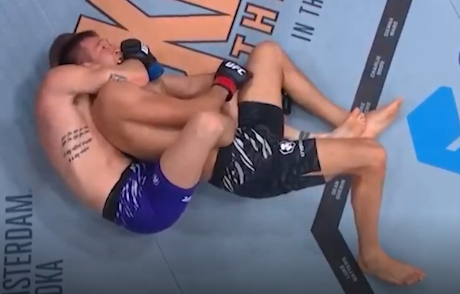
The Carlos Prates fight looked different because Garry still landed 28 significant strikes in the fifth, but his movement became less reliable as Prates kept pressing forward. In that round, Garry went 0-for-6 on takedowns, gave up 1:01 of control and absorbed 12 significant ground strikes.
Garry later said he was not hurt and remained conscious throughout the exchange. Whatever the case, his movement and choices looked desperate in my opinion. That performance is not enough to say he has poor cardio. He did not stop working, but obviously his ability to move and make good decisions declined. The fifth round is gonna be interesting if they make it there.
Rumors & Reputations
Javier Mendez has said Makhachev may not even need to take Garry down. Most likely a bluff but I think what he’s trying to say is they have several plans based off how Ian Garry approaches the fight. They need to make some reads before committing to anything specific. In fact, this sounds oddly familiar…
I interpret this as: Makhachev does not need to force the takedown. The threat of wrestling can still affect Garry’s reactions.
Of course, there is still a risk in giving Garry too much time at range. He is longer, faster and comfortable building rounds through volume and accumulation. Makhachev may not need to take him down the entire fight, but he’ll definitely want Garry reacting to the feints.
For Ian Garry, it’s worth noting a few things he’s done in preparation for Islam Makhachev:
- He flew to Georgia to get some work in against southpaw wrestlers.
- According to Diego Lima, Garry’s MMA coach, he’s had two months of opponent-specific prep for Makhachev; this does not include his trip to Georgia.
- Training with Chucky Olives and Demian Maia. “intensive camp specifically focused on the grappling exchanges they expect against Makhachev.”
- From what I can gather he also traveled to Spain (Maia), did some work in England, and is finishing up sparring in Dublin.
- His cornermen for this fight are reported to be: Diego Lima, John Hathaway, Demian Maia, Paulo Mauricio Strauch
Pick & Prediction
Personally, I find this fight so intriguing. I love a classic style matchup, and this one fits perfectly.
At the time of writing this, Ian Garry is nearly a 3-to-1 underdog on most books. Oddschecker has Garry at +290 and Makhachev at -340, while BestFightOdds shows Garry sitting between roughly +250 and +303 depending on the book. Polymarket currently gives Garry a 26% chance of winning, which converts to roughly +285 in American-odds terms.
Polymarket has Fight Goes the Distance at 44% and End Inside the Distance at 56%. FanDuel has Makhachev by decision at +135 and Makhachev by submission at +210. Garry by decision is sitting at +450.
I think it’s safe to say that Makhachev by decision or submission is the likely route this fight goes if we’re judging by the odds. Garry by decision at +450 on FanDuel is a very real possibility for Ian Garry. Garry winning by TKO/KO is something I see as less likely but still a real possibility.
There is poison to pick from if you choose to do so.
The reason I drill into posting and framing so much in this breakdown is because I think that is his first line of defense and his best opportunity to counter Islam Makhachev. It is similar but different from the path Conor McGregor tried to take with Khabib and other wrestlers.
We saw glimpses of these tactics from Garry against Belal Muhammad.
Garry reading entries and choosing to prioritize posting off the head and shoulder, extending that frame to keep the hips safe at the risk of the entry not even being a takedown, trusting in his chin and slips to then counter with combinations and exit out of range—that is the whole thing here.
I have no question in my mind that Makhachev will be landing punches as well because Garry has been hit by every one of his shorter southpaw opponents in the past, but it’s up to Garry not to let Makhachev stack those punches on top of control time.
Garry will need sustained volume and the punches landed will need to be more impactful than they ever have before.
I see both these guys battering each other’s lead leg. How dedicated will Garry be to the knee/thigh stomps he often goes to against someone like Makhachev?
Garry had zero respect for Belal Muhammad’s wrestling abilities and stomped him freely throughout that entire fight. Belal officially completed zero takedowns, and Garry won by unanimous decision.
Fascinating matchup, but for now, I’m rolling with the fighter who has a higher likelihood of dictating where this fight takes place: Islam Makhachev.
However, as fight week progresses and I try to catch subtle hints of tactics, game plans, and, of course, both of their general health going into the fight, I may make a switch on my official pick.
Betting-wise? I don’t see any reason not to lay down a couple of bones on the Ian Garry moneyline. In my eyes, I see Garry as a 2-to-1 underdog so getting him at 3-to-1 seems like a good opportunity to take a small risk.
Pick: Islam Makhachev by DEC.
I reserve the right to change my pick prior to the fight, but all official picks are recorded on Verdict MMA.
p.s.
My side prediction is we may see a lot of eye pokes from Ian Garry. Not intentional ones but because he’ll be looking to frame. This happened against Belal Muhammad but I anticipate it being much more prevalent in this fight. The real question is, will the ref take a point?